Inflammation
Swelling, pain, warmth — the phase where symptoms often peak.
Whiplash, sprains, and strains are the most common crash injuries in California — and the easiest to under-document. This desk explains soft-tissue injury mechanics, grading, and the evidence file. No invented numbers, no advice dressed as information.
Medical emergency? Call 911. This site does not diagnose injuries.
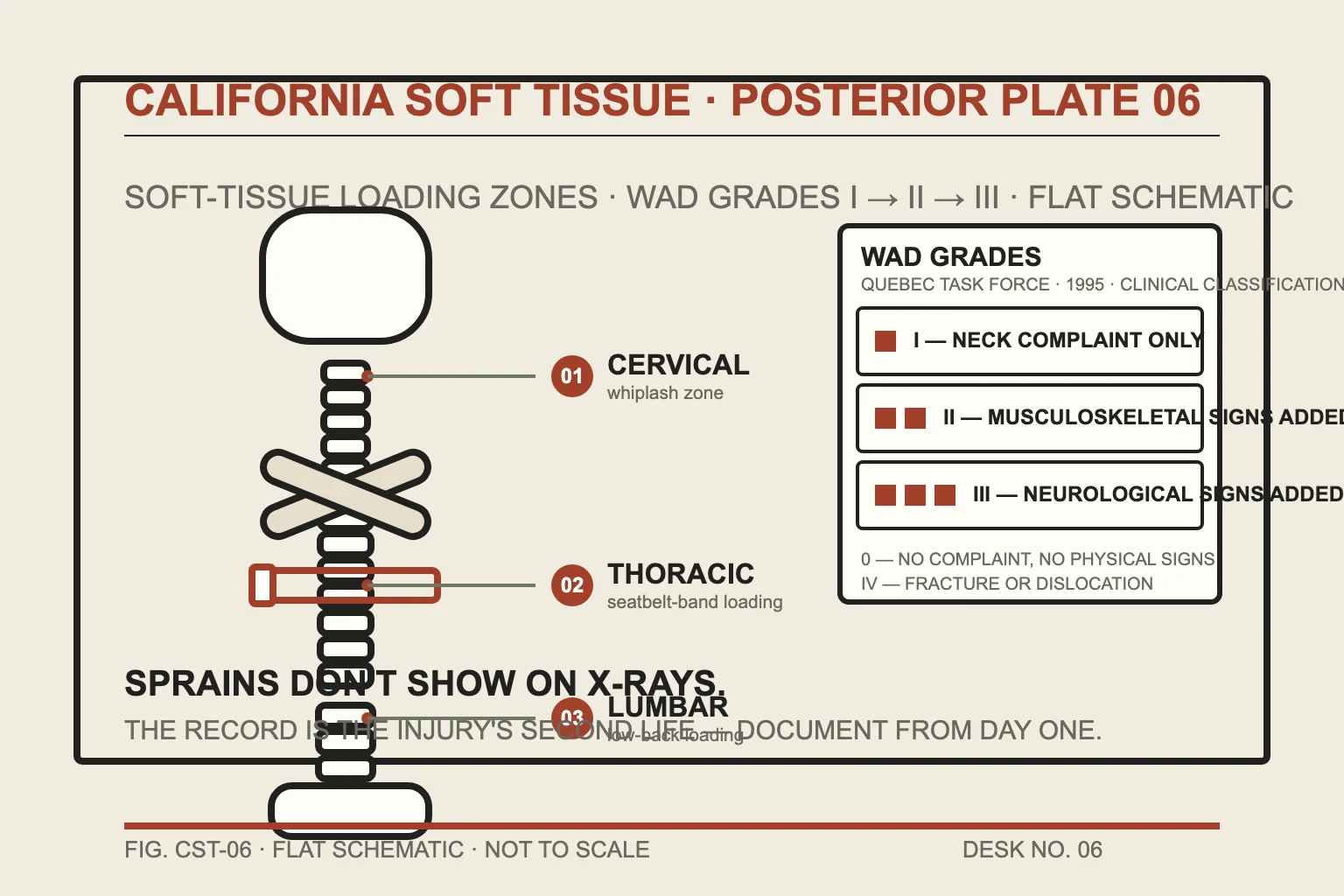
Cervical — whiplash zone
02Thoracic — seatbelt band
03Lumbar — low-back loading
Each carries its source. Every topic file expands on these.
Whiplash-associated disorders are classified WAD 0 through IV by the Quebec Task Force — a public 1995 classification clinicians still use.
Radiography resolves bone. Soft tissue — ligament, tendon, muscle — reads as shadow. That is the root of the underestimation problem.
Pain and stiffness after a crash commonly peak 24 to 72 hours later — the timing is the injury's physiology, not its absence.
Personal-injury lawsuits must generally be filed within two years of the injury under Code of Civil Procedure §335.1.
Pain and stiffness after a crash commonly build over the first 24 to 72 hours.Quebec Task Force on Whiplash-Associated Disorders — Spine 1995
Soft-tissue injuries live in records, not in X-rays. Four documents carry the weight — the crash record, the medical record, the loss record, and your own dated notes — and the documentation gap is where valid injuries get lost.
Start the injury file →Swelling, pain, warmth — the phase where symptoms often peak.
New tissue is laid down — present but not yet strong.
Strength returns last; loading too early sets the repair back.
Dated notes through the course — the file is the injury's second life.
Causation, consistency, course — each read from the record.
Three statutory anchors organize everything downstream of a soft-tissue injury: the SR-1 report to the DMV within 10 days where the statute requires it (Vehicle Code §20008); the two-year filing period for a personal-injury lawsuit (Code of Civil Procedure §335.1); and the SB 1107 minimum limits of $30,000 / $60,000 / $15,000 for policies issued or renewed on or after January 1, 2025. Get fact-specific advice early.
Read the claims file →Every file distinguishes medical information from California legal and insurance guidance. The desk grounds itself in the statutes (leginfo), DMV guidance, and peer-reviewed or professional-association sources — the Quebec Task Force monograph, AAOS OrthoInfo, NIH MedlinePlus — so readers can move from a plain-language explanation to the underlying authority.